
As a soon-to-be retired professor of U.S.-Latin American relations, immigration and its causes, is an undeniable central issue of the past forty years. I studied history in college as the civil wars in Central America and the Dirty Wars in South America were underway. Those wars, and the U.S. complicity in those wars framed my historical lens. Since 2023, I’ve worked with a local Presbyterian church in taking people to the Arizona/Mexico border through Frontera de Cristo, a Presbyterian-based ministry located in Douglas, AZ. This year, we didn’t have a firm delegation committed, so I decided to do the Migrant Trail as a fundraiser to raise money and awareness for/ about Frontera, and a local, South Carolina nonprofit, the Carolina Immigrant Alliance, which helps immigrants with necessary documents and paperwork. (If you wish to make a donation to this fundraiser to support the two groups mentioned you can do so here: https://onrealm.org/ProvidencePresb18431/give/migranttrailwalk.) I made the decision to do this trek in late March and had only scant awareness about what the whole journey would entail. I consider myself a feet-first type of person, though, and decided to jump in and then quickly learn about what I was doing.
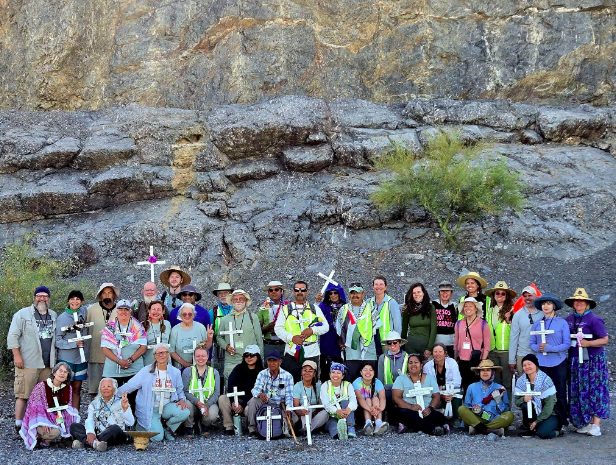
I signed up for the 23rd annual Migrant Trail, from Sasabe to Tucson, Arizona, the week of May 25-31. I knew nobody, and although I read the participant packet (mostly), I didn’t know exactly what to expect. The group of approximately 40 walkers convened at Shalom Mennonite Church in Tucson on Sunday, May 24, for a four-hour orientation/ training session. During the training session, each of us committed to serving on a team, which had daily work assignments. I joined the Food Team, which set up and broke down each meal, daily snacks, and set up washing stations after lunch and dinner each day. We learned at our training that over 8,000 migrants had perished in the landscape where we would walk, and 109 had died since the previous May.
My biggest fear, before starting, was that I didn’t have all the things I needed for the seven-day trek. That proved right, and partly because I misunderstood that we needed to pack EVERYTHING in one bag—we didn’t—our gear, including tents, folding chairs, and sleeping bags could have been packed separately. For that reason, I ditched my sleeping bag because it took up 1/3 of my duffle bag. That was a mistake as the first two nights were very cold. Rolande, a colorful, dedicated Tucson activist, who accompanied the group with her own vehicle, lent me a blanket on day 3, which made subsequent nights better.
We began our journey with a ceremony and press conference at Southside Presbyterian Church in Tucson. This was the most beautiful church I’ve ever seen outside historic cathedrals in Europe and Latin America. Pure, simplistic beauty. At this service, each of us took a cross with the name of someone who had died crossing the desert. My cross said “desconocido,” (unknown male) 2006-2007, representing an unidentified male who had died during that year. Most of our crosses bore the same name because few bodies are ever clearly identified.
We rode in cars from Tucson to Sasabe on Monday morning, which is approximately a 2.5-hour drive (I was captivated by the conversations in the vehicle because everyone was interesting and everyone had a story.) After a moving Native American prayer ceremony, we began our trek in Sasabe, along with people who were hiking with us for the first day only. By the end of the day, it became clearer who was in our group for the week.
I wanted to participate in this journey to deepen my commitment to working on immigration issues/policies in the United States, which most of us understand are deeply problematic. I wanted to learn more about the desert and the terrain that many undocumented are forced to negotiate, and I wanted to deal with some of my own grief that had compounded over several decades. We walked between ten and sixteen miles every day except for the first day, which was barely over seven. We began most days by 6 a.m. but began walking one day at 3:30 a.m. to protect ourselves during the hottest part of the day. I’m very near-sighted and exactly “half blind,” which adds an important dimension to waking up in the middle of the night and packing everything quickly. Our journey was mostly a solemn one, but not entirely. Every other “leg” of the trek we walked in silence. This silence grounded us and I grew to look forward to it. Every other stop we would iterate the “Presente” litany, calling out the names of the (dead) people on our crosses and all responding to each name, in unison, “Presente!” – meaning we/they are here with us. We walked single-file on paved roads and highways and two-by-two when off-road. I ended up walking near some of the same people. Ellen is a retired schoolteacher from Chicago, who now lives in Flagstaff, and was usually close by. She pointed out all the “foreign” plants along the way. I had never seen a mesquite plant before but learned to step carefully around them. The Saguaro cacti were majestic. We sometimes had to be reigned in for walking too fast. We were constantly reminded to drink water as it is easy to dehydrate in the desert.
I started out sleep-deprived and squarely rooted on Eastern Standard Time. I didn’t sleep at all the first night, so went into day two exhausted. I eventually slept more and felt better as the week wore on. At all times we were accompanied by at least four vehicles carrying food, water, our gear, and port-potties, all the things that migrants themselves do not have access to. We were all aware of the fact that while others do this alone unaided, we had ample support.
Committed groups accompanied us on this journey—churches and various humanitarian organizations. Humane Borders of Tucson brought us a lot of water and sometimes allowed us to spray ourselves with hoses- something I greatly looked forward to. Frontera de Cristo, from Douglas/ Agua Prieta, came and brought us dinner on our first night. A couple of Tucson organizations brought us several meals. On Thursday night we had a real shower and flush toilets, as we stayed in a campground. We were all appreciative of the luxury of a real shower. Buddhist monks from Tucson prepared us a delicious Thai meal on Friday, which we ate in a Baptist church that allowed us to stay inside the sanctuary for the night. Friday happened to be my 62nd birthday. This was the first birthday that I’ve ever spent with people that I didn’t know, but I felt embraced and appreciated by a wonderful group of kindred souls—a diverse group of different people who all shared many of the same values about humanity. We were, in the words of Harvard philosopher and theologian, Josiah Royce, “A Beloved Community.” That night, in the church we had a talent show. Several people sang, we all learned a line dance, and several recited words from sage poets and writers.
As we approached Tucson on our last day, many cars beeped at us as we walked along the highway. As far as I could tell, nobody heckled us or jeered us. Border Patrol cars passed by many times during the walk but left us alone. If the Border Patrol had given us a hard time, I was certain that Rolande would have “politely” scolded them and sent them on their way. We finished our walk at Kennedy Park in Tucson, where kindred organizations met us with food and a warm reception. An Episcopal priest washed the feet of twelve of our participants. He kissed the ground before each washing and then kissed the feet of each individual. It was moving– I was tired; I cried tears of happiness, sadness, and relief.
While the Migrant Trail isn’t for everyone, it is a moving experience for those of us concerned about our brothers and sisters who feel compelled to leave their homes because of violence, genocide, war, and climate change. It’s a good way to deepen our commitment and understanding of how U.S. policies perpetuate the conditions that compel people to migrate. It’s a great experience for those of us who often feel alone with our personal convictions about how to confront the hegemonic powers that wield injustice. It’s something we can DO in solidarity with others.
Mohyeddin, a soon-to-be 79-year-old Palestinian and a mainstay on the Migrant Trail, kept us focused on the intersectional issues that compelled our walk. Each time we would recite the Presente litany, he professed loudly: “Desconocido! Desconocida! Desconocido/a! … Victims of War, Genocide, and Violence Everywhere!” Another world is indeed possible. For more about the Migrant Trail go here: https://azmigranttrail.com.
With gratitude,
Ginger Williams